
Smarter choices: the swaps that change your week
Protein, fibre, keyhole labels, sugar traps, drinks, sauces and lighter sweets — the concrete swaps from the Smarta val-guiden, with the numbers behind them.
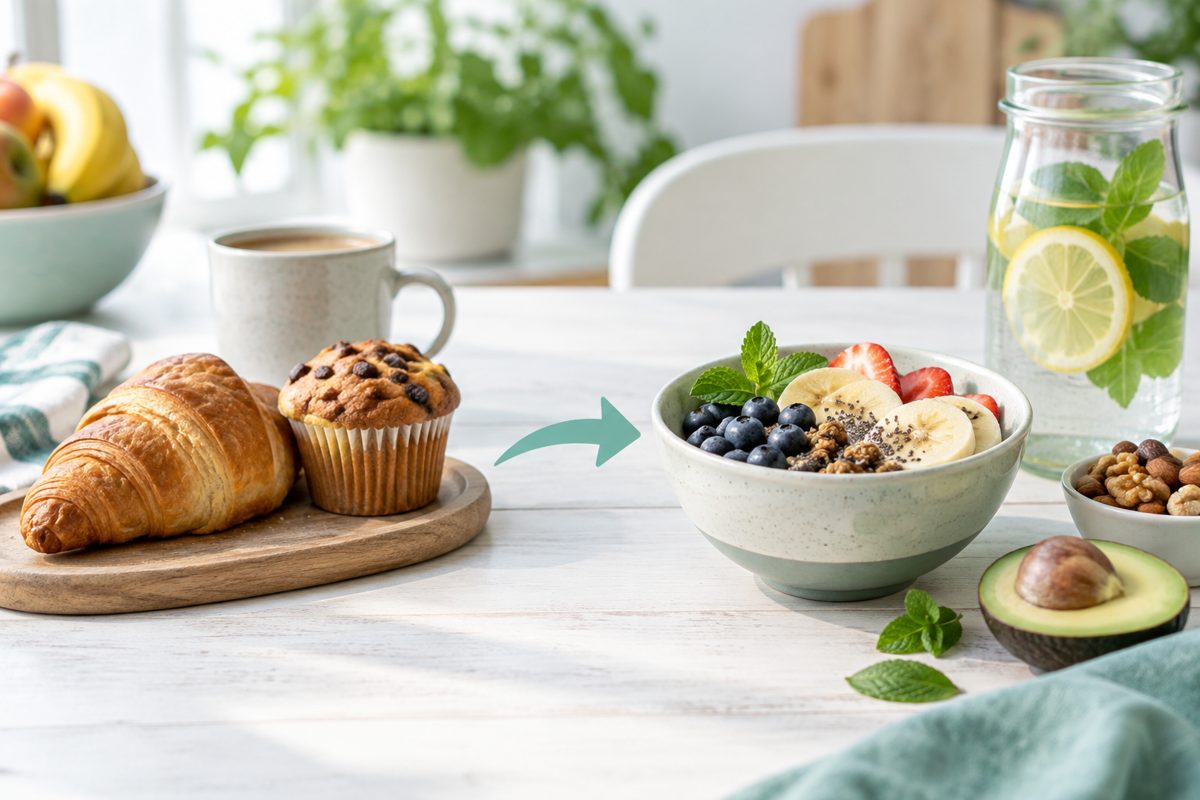
Most people do not need a new diet. They need a handful of swaps that quietly change what an ordinary week looks like. That is the whole idea behind our Smarta val-guiden: put two similar products side by side, look at the numbers, and pick the one that gives you more of what you actually want — protein and fibre — with less of what sneaks in unnoticed, mainly fat and sugar.
Protein: same meal, very different numbers
A good protein source gives you at least 15 g per 100 g, and at lunch and dinner you want to land at 20–30 g in total. The trap is that many protein foods carry a lot of fat or sugar along for the ride. The comparisons in the guide make it obvious:
- Falukorv: 260 kcal, 9 g protein, 23 g fat — chicken breast: 165 kcal, 31 g protein, 3.6 g fat
- Meatballs: 260 kcal, 13 g protein, 15 g fat — beef mince 5 %: 129 kcal, 21 g protein, 5 g fat
- Bacon: 300 kcal, 13 g protein, 28 g fat — chicken bacon: 140 kcal, 16 g protein, 7.3 g fat
- Brie: 350 kcal, 12 g protein, 17 g fat — cheese 10 %: 221 kcal, 32 g protein, 10 g fat
- Sweetened yoghurt: 3.7 g protein, 8.5 g sugar — quark 0.2 %: 9.7 g protein, 3.5 g sugar
Nothing here is forbidden. But if falukorv becomes chicken breast twice a week, you have added protein and removed a substantial amount of fat without changing a single habit around the table.
Fibre and wholegrain: aim for 25–35 g a day
We need 25–35 g of fibre a day, and most of us fall short. Fibre matters for digestion, for blood sugar and for the gut flora. Wholegrain — the entire grain with bran, germ and kernel — brings fibre, vitamins and minerals in the same package. Good sources per 100 g: oats 10 g, rye bread 10 g, crispbread 15 g, wholegrain pasta 7–8 g, wholegrain flour 10–12 g. Legumes deliver too: lentils 8 g, chickpeas 7 g, black beans and soy beans 6 g, edamame 5 g. Seeds are in a league of their own — chia 34 g, flaxseed 27 g, almonds 12 g.
Two snacks worth knowing about: home-made popcorn without butter gives 10 g fibre and around 120 kcal per 100 g (microwave butter versions land near 350 kcal), and Finn Crisp chips give a full 17 g fibre per 100 g at about 400 kcal — but a few chips is usually enough. One important detail: increase your fibre gradually and drink plenty of water, otherwise your stomach will protest.
Let the keyhole label do the work
When you are standing in front of the bread or cereal shelf and do not want to read labels, use the keyhole symbol as a shortcut: keyhole-marked products contain more fibre and wholegrain and less sugar. The guide shows the difference clearly — Pågenlimpan has 3.8 g fibre and 11 g sugar per 100 g, while chia bread has 7.8 g fibre and 2.5 g sugar. Lingongrova: 6.1 g fibre, 9 g sugar, against Fiberrost at 5.7 g fibre and 4.2 g sugar. In the cereal aisle the gap is bigger still: Nesquik lands at 22.5 g sugar per 100 g, Havrefras at 14 g fibre, 8.6 g sugar and 14 g protein.
The sugar traps
Use Coca-Cola as your reference point: 10.6 g sugar per 100 g. Now compare that to foods with a healthy reputation. Juice: 8.8 g. Innocent smoothie: 10 g. Risifrutti: 10 g. Greek yoghurt: 12 g. Muesli Gold Original: 22 g. A Corny Big chocolate bar: 32.5 g. A protein bar can hold 21 g sugar. And the dried fruit and 'natural sweets' corner is the biggest surprise of all — raisins 71 g, mixed dried fruit and nuts around 45 g, ordinary sweets 57 g.
The point is not that raisins are bad. It is that a handful of raisins is not the low-sugar choice you thought it was, and that knowing this lets you decide on purpose rather than by accident.
Drinks: the calories you forget to count
Liquid calories are the easiest ones to drink without noticing. A 33 cl Coca-Cola is 140 kcal and 35 g sugar; the Zero version is 0.5 kcal and no sugar. Red Bull: 110 kcal and 27 g sugar, against 3 kcal for the sugar-free one. Alcohol is its own category at 7 kcal per gram and is often a major reason weight will not budge: a 50 cl beer at 5 % is 250 kcal, a 15 cl glass of wine 120 kcal, a 4 cl shot 90 kcal. Cocktails climb fast — mojito 217 kcal, piña colada 230 kcal, margarita 241 kcal.
Sauces and lighter sweets
Sauces can quietly double the energy in a meal. Béarnaise and mayonnaise both land at 700 kcal and 77 g fat per 100 g; light crème fraîche with flavour is 140 kcal and 11 g fat, light mayonnaise 320 kcal. Kebab sauce goes from 500 kcal to 132 kcal in its mild version. Tzatziki is 120 kcal, low-sugar ketchup 64 kcal and salsa just 32 kcal per 100 g.
And when the sweet craving hits, you do not have to white-knuckle it. Nicks chocolate ice cream is 131 kcal, 5.6 g sugar and 7.8 g protein per 100 g. Arla protein pudding: 77 kcal, 4.4 g sugar, 10 g protein. Barebells protein bar: 367 kcal but 36 g protein and 3.6 g sugar. Wellbites and Läkerol come in around 204–209 kcal with no sugar at all, and sugar-free 72 % dark chocolate works beautifully for baking.
Understand the whole picture
It is easy to get stuck on calories, sugar or a single nutrient. To really understand your food you need the whole picture — and that is exactly what the guide is a first step towards. Download the full Smarta val-guiden at nutraware.com/pdf/Smarta_val_guiden.pdf and keep it on your phone the next time you shop.
With Nutraware you can scan a product straight in the store and get all the nutritional information in one place, a plain explanation of what it contains, and an assessment of how well it fits your needs and goals. You can also photograph a meal for a complete analysis, follow your habits over time and get personal advice from AI-Sarah. Scan. Understand. Choose consciously.
Want to put this into practice? Nutraware lets you photograph your meals for an instant nutritional analysis, track your habits and get personal coaching from an AI built on science. Be aware, feel great — and let the app do the counting for you.